Nearby
Wat Ku
A riverside Chao Phraya temple in Pak Kret, home to two shrines for the Princess Who Drowned and a 37-metre reclining Buddha
- Map
- อำเภอปากเกร็ด จังหวัดนนทบุรี
Wat Ku is an old temple on the Chao Phraya River in the Pak Kret district of Nonthaburi. It is known for its Mon-style art, two shrines dedicated to the Princess Who Drowned, and a reclining Buddha 4 metres wide and 37 metres long, housed in an open-air pavilion right at the temple entrance. English-language sources date its construction to 1752, while Thai sources describe it as an old temple dating back to the Thonburi period. According to local tradition, it was built by Phraya Cheng, the leader of a Mon family who settled on Koh Kret. For anyone attending an event at IMPACT, our research is clear on one point: you cannot walk here from the halls. A car or taxi is the only way.
What sets Wat Ku apart from other riverside temples in the area is its connection to Queen Sunandha Kumariratana, consort of King Chulalongkorn (Rama V), who was pregnant at the time of her death. Her royal barge capsized in the Chao Phraya River near Bang Phut subdistrict while she was travelling to Bang Pa-in Palace in Ayutthaya. The accident killed Queen Sunandha at the age of 19, along with her daughter, Princess Kannabhorn Bejraratana, and her nanny, Kaew. Because a law at the time forbade commoners from touching members of the royal family, no one dared go to their aid. That law was later abolished, and the temple's name, Wat Ku, meaning the rescue temple, comes from this tragedy.
Historical accounts say the Queen's body was brought to Wat Ku and enshrined there temporarily before being taken to the Grand Palace. The wreckage of the boat that sank is kept in a boathouse near the reclining Buddha's pavilion, and a separate memorial stands at Bang Pa-in Palace, the original destination of that royal journey.
Why IMPACT event-goers pick this place
- It is a historical site in the same province as Muang Thong Thani, Nonthaburi, so it is an easy same-day stop from an IMPACT event without heading into central Bangkok.
- The main sights are clustered in one compound: two shrines to the Princess Who Drowned, a 37-metre reclining Buddha, Mon-style mural paintings in the viharn, and the wreckage of the boat kept in a boathouse. You can see everything in a single visit.
- It is a riverside temple with a quiet, open feel, good for a break before an event or after a full day walking the halls.
- The story of the Princess Who Drowned is tied directly to the Pak Kret area. Visitors from other provinces or overseas guests attending IMPACT rarely make it out this way, which makes it a worthwhile detour.
- You can reach it by car or by boat, disembarking at Pak Kret Pier, so it pairs easily with a wider trip around Pak Kret.
- Visitors often wear Thai traditional dress to pay respects at the riverside shrine, making it both a place of worship and a photo spot in one.
What is Wat Ku, Pak Kret, and what is its history?
Wat Ku is an old temple on the Chao Phraya River in the Pak Kret district of Nonthaburi. English-language sources date its construction to 1752, while the Thai record describes it as an old temple dating back to the Thonburi period (1767 to 1782). According to tradition, it was built by Phraya Cheng, the leader of a Mon family who migrated and settled on Koh Kret. The temple's art is Mon in style, most visible in the mural paintings inside the viharn.
The name Wat Ku comes from the tragedy of the royal barge that capsized in the Chao Phraya River near Bang Phut subdistrict, during a royal procession to Bang Pa-in Palace. Queen Sunandha Kumariratana, consort of Rama V, who was pregnant at the time, died at the age of 19, along with her daughter, Princess Kannabhorn Bejraratana, and her nanny, Kaew. No one dared go to their aid because of a law forbidding commoners from touching royalty, a law that was later abolished. The Queen's body was later brought to this temple and enshrined temporarily before being taken to the Grand Palace.
- Location: Pak Kret district, Nonthaburi, on the Chao Phraya River
- Year built: English sources say 1752; Thai sources describe it as dating to the Thonburi period
- Traditional founder: Phraya Cheng, leader of a Mon family who settled on Koh Kret
- Art style: Mon, visible in the viharn's mural paintings
- Origin of the name: the royal barge tragedy and the temporary enshrinement of the Queen's body at the temple
What is there to see at Wat Ku?
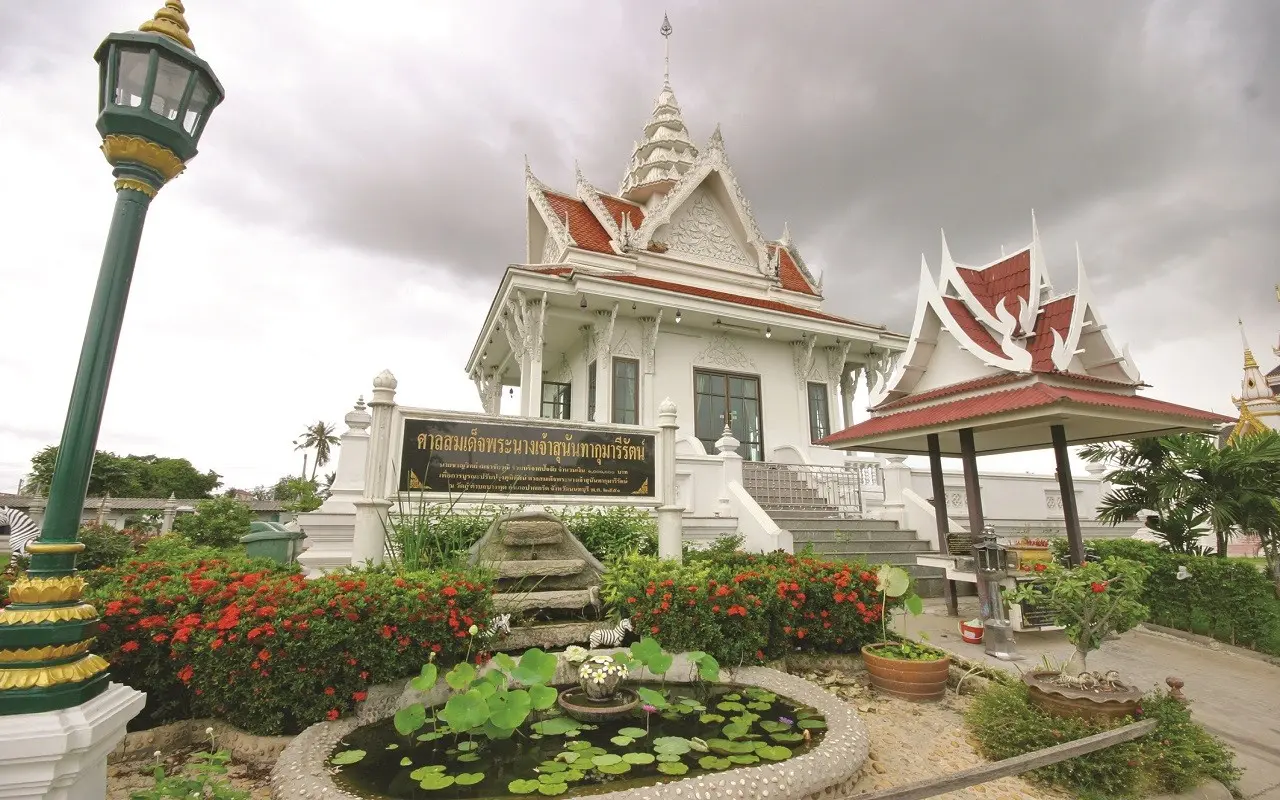
The temple's main draw is its two shrines to the Princess Who Drowned. The first sits by the riverbank, where visitors commonly wear Thai traditional dress to pay their respects. The second, the original shrine, stands within the temple grounds near the reclining Buddha.
Wat Ku's reclining Buddha is 4 metres wide and 37 metres long, several hundred years old, and housed in an open-air pavilion at the temple entrance. There is no clear record of when it was built, though it is thought to date from around the same time as the temple. Near the pavilion is a boathouse holding the wreckage of the boat that sank. For those interested in the fuller story, a second memorial to the Princess Who Drowned stands at Bang Pa-in Palace in Ayutthaya, the original destination of that royal journey.
- Riverside shrine to the Princess Who Drowned, where visitors often wear Thai traditional dress to pay respects
- Original shrine to the Princess Who Drowned, within the temple grounds near the reclining Buddha
- Reclining Buddha, 4 metres wide and 37 metres long, in an open-air pavilion at the temple entrance
- Mon-style mural paintings inside the viharn
- Boathouse holding the wreckage of the sunken boat, near the reclining Buddha's pavilion
How do you get to Wat Ku from IMPACT Muang Thong Thani? Can you walk?
No, you cannot walk there. A car is required. Our research is consistent across every hall: IMPACT Arena, Thunder Dome, IMPACT Challenger, and IMPACT Exhibition Hall are all too far to walk to Wat Ku. Plan on a private car, taxi, or ride-hailing app from outside the hall instead.
Another option is to travel by boat along the Chao Phraya River and disembark at Pak Kret Pier, a good choice if you want to combine Wat Ku with a wider trip around the Pak Kret area, since the temple sits on the riverbank within the Pak Kret community. For exact travel times, check a map app before setting out, as the roads around Chaeng Watthana and Pak Kret get congested during rush hour.
- From IMPACT Arena and Thunder Dome: too far to walk, a car is required
- From IMPACT Challenger: too far to walk, a car is required
- From IMPACT Exhibition Hall: too far to walk, a car is required
- By boat: along the Chao Phraya River, disembarking at Pak Kret Pier
- Address to pin: Pak Kret district, Nonthaburi
Wat Ku admission fee and opening hours
The official sources we have do not list opening hours or an admission fee for Wat Ku, so we will not state figures we cannot confirm. Check with the temple directly before travelling, especially if you are planning an evening visit after an event at the halls, or a visit on a religious holiday when it may be busier than usual.
In practice, a riverside temple like this is better visited during the day, since the main draw, the reclining Buddha's pavilion, is open-air, and the riverside shrine offers the best views of the Chao Phraya in daylight.
- Opening hours: not listed in official sources, ask the temple directly
- Admission fee: not listed in official sources, ask the temple directly
- Best time to visit: daytime, since the reclining Buddha's pavilion is open-air and the shrine sits by the river
Who is it for, and how long should you plan?
Wat Ku suits anyone interested in old temples, royal history, and Mon art, as well as IMPACT visitors with a free half-day or a morning before the halls open. The must-see points are few and clustered together within the temple grounds: two shrines, the 37-metre reclining Buddha pavilion, the mural paintings, and the boathouse. A relaxed walk through takes about 45 minutes to an hour. Add time for paying respects and taking photos by the river, and plan for around an hour and a half.
It is suitable for visitors with older relatives or young children too, since it is mostly flat walking around the temple grounds, with none of the steep stairs you would find at a hilltop temple. Bring sun protection though, as the riverside area and open-air pavilion get hot in the afternoon. As it is a place of worship, dress modestly and keep noise down.
- Approximate visit time: 45 minutes to 1 hour for the main points
- Allow extra time for prayers and photos: about 1.5 hours total
- Good for: history enthusiasts, temple visitors, families, older travellers, and Thai costume photography
- Dress modestly, as is customary when visiting a temple
Wat Ku, Pak Kret quick facts
A summary for anyone planning a stop while attending an event at IMPACT Muang Thong Thani. Every line below comes from official sources and our own distance data. Where information is not confirmed, we say so clearly and point you to the temple directly.
- Name: Wat Ku, Pak Kret (Wat Ku)
- Location: Pak Kret district, Nonthaburi, on the Chao Phraya River
- Highlights: two shrines to the Princess Who Drowned, a reclining Buddha 4 metres wide and 37 metres long, Mon-style mural paintings, a boathouse with the wreckage of the sunken boat
- History: linked to Queen Sunandha Kumariratana, consort of Rama V, who died at the age of 19
- Getting there from IMPACT: too far to walk from any hall, a car is required, or arrive by boat at Pak Kret Pier
- Approximate visit time: 45 minutes to 1.5 hours
- Opening hours and admission: not listed in official sources, ask the temple directly
Frequently asked questions
Where is Wat Ku, Pak Kret?
Wat Ku sits on the Chao Phraya River in the Pak Kret district of Nonthaburi, the same province as Muang Thong Thani. Inside the temple are three main points of interest: two shrines to the Princess Who Drowned, the 37-metre reclining Buddha pavilion, and a boathouse holding the wreckage of the sunken boat.
Can you walk from IMPACT to Wat Ku? How do you get there?
No, you cannot walk. A car is required. Our research shows that IMPACT Arena, Thunder Dome, IMPACT Challenger, and IMPACT Exhibition Hall are all too far to walk to Wat Ku. Use a private car, taxi, or ride-hailing app from outside the hall. An alternative is to travel by boat along the Chao Phraya River and disembark at Pak Kret Pier.
What time does Wat Ku open?
The official sources we have do not list opening hours for Wat Ku, so check with the temple directly before travelling, especially for an evening visit after an event at the halls. Since the main sight, the reclining Buddha's pavilion, is open-air, and the other shrine sits by the river, a daytime visit works best.
How much does it cost to enter Wat Ku?
Official sources do not list an admission fee for Wat Ku, so we will not confirm a figure. Check with the temple directly. The cost to actually budget for is the return trip from IMPACT, since none of the four halls are within walking distance.
Is Wat Ku the temple of the Princess Who Drowned?
Yes. Wat Ku is tied to the story of the Princess Who Drowned, Queen Sunandha Kumariratana, consort of King Chulalongkorn (Rama V). Two shrines to her stand within the temple, and records say her body was brought here and enshrined temporarily before being taken to the Grand Palace.
How many shrines to the Princess Who Drowned are at Wat Ku, and where are they?
There are two. The first sits by the Chao Phraya riverbank, where visitors commonly wear Thai traditional dress to pay respects. The second is the original shrine, within the temple grounds near the reclining Buddha. Both are within walking distance of each other in the same compound.
Why is it called Wat Ku?
The name comes from the tragedy of a royal barge that capsized in the Chao Phraya River near Bang Phut subdistrict, while travelling to Bang Pa-in Palace. Queen Sunandha Kumariratana, who was pregnant at the time, died at the age of 19, along with her daughter, Princess Kannabhorn Bejraratana, and her nanny, Kaew. A law at the time forbade commoners from touching royalty, so no one dared help. Her body was later brought to this temple, and locals came to call it Wat Ku, meaning the rescue temple.
How big is the reclining Buddha at Wat Ku, and where is it?
Wat Ku's reclining Buddha is 4 metres wide and 37 metres long, several hundred years old, and housed in an open-air pavilion at the temple entrance, visible as soon as you walk in. There is no clear record of when it was built, though it is thought to date from around the same time as the temple.
When was Wat Ku built, and who built it?
Sources differ. English-language records date it to 1752, while Thai records describe it as dating from the Thonburi period. Tradition holds it was built by Phraya Cheng, the leader of a Mon family who migrated and settled on Koh Kret, Nonthaburi, which is why the temple's art is Mon in style.
Can you get to Wat Ku by boat? Which pier?
Yes. Travel along the Chao Phraya River and disembark at Pak Kret Pier, since the temple sits on the riverbank within the Pak Kret community. This works well if you want to combine Wat Ku with a wider trip around Pak Kret. If you are at IMPACT with limited time, going by car is easier to plan around.
How long does a visit to Wat Ku take?
About 45 minutes to an hour to see the main points: the two shrines to the Princess Who Drowned, the 37-metre reclining Buddha pavilion, the Mon-style murals, and the boathouse. Add time for prayers and riverside photos, and allow around an hour and a half.
I have half a day at IMPACT. Can I fit in a stop at Wat Ku?
Yes, if you have around two hours or more free, since the walk through the temple itself takes about an hour, with the rest spent on the round trip. The best windows are early morning before the halls open, or a break during the day. Check traffic around Chaeng Watthana and Pak Kret on a map app first, as it gets congested during rush hour.
Can I wear Thai traditional dress for photos at Wat Ku?
Yes, and it is a common sight, especially at the riverside shrine to the Princess Who Drowned, where visitors often dress up to pay respects. As it is a place of worship, dress modestly and behave respectfully while on the grounds.
Is Wat Ku suitable for children and older visitors? Is there parking?
Yes. It is mostly a walk around a riverside temple, with the three main points close together and no steep stairs, and the reclining Buddha's pavilion sits right at the entrance. Official sources do not give parking details, so check with the temple directly, and allow extra time on religious holidays when it can get busier than usual.
How is Wat Ku connected to Bang Pa-in Palace?
Bang Pa-in Palace in Ayutthaya was the original destination of the royal journey during which the boat capsized, and a memorial to Queen Sunandha Kumariratana was later built there as well. Visitors interested in the full story often combine both stops, usually starting with Wat Ku in Pak Kret, which is closer to Muang Thong Thani.
Facts from the official website, last checked 31 Aug 2026